Practical Guide for ROCS Billing
Illinois DHS ROCS Billing Software: A Practical Guide for Billing & Program Directors
Introduction:
Are month-end fire drills, ROCS rejections, and manual file uploads slowing your cash?
Do you manage CILA, day programs, and vocational sites across multiple providers—and worry something will slip through the cracks?
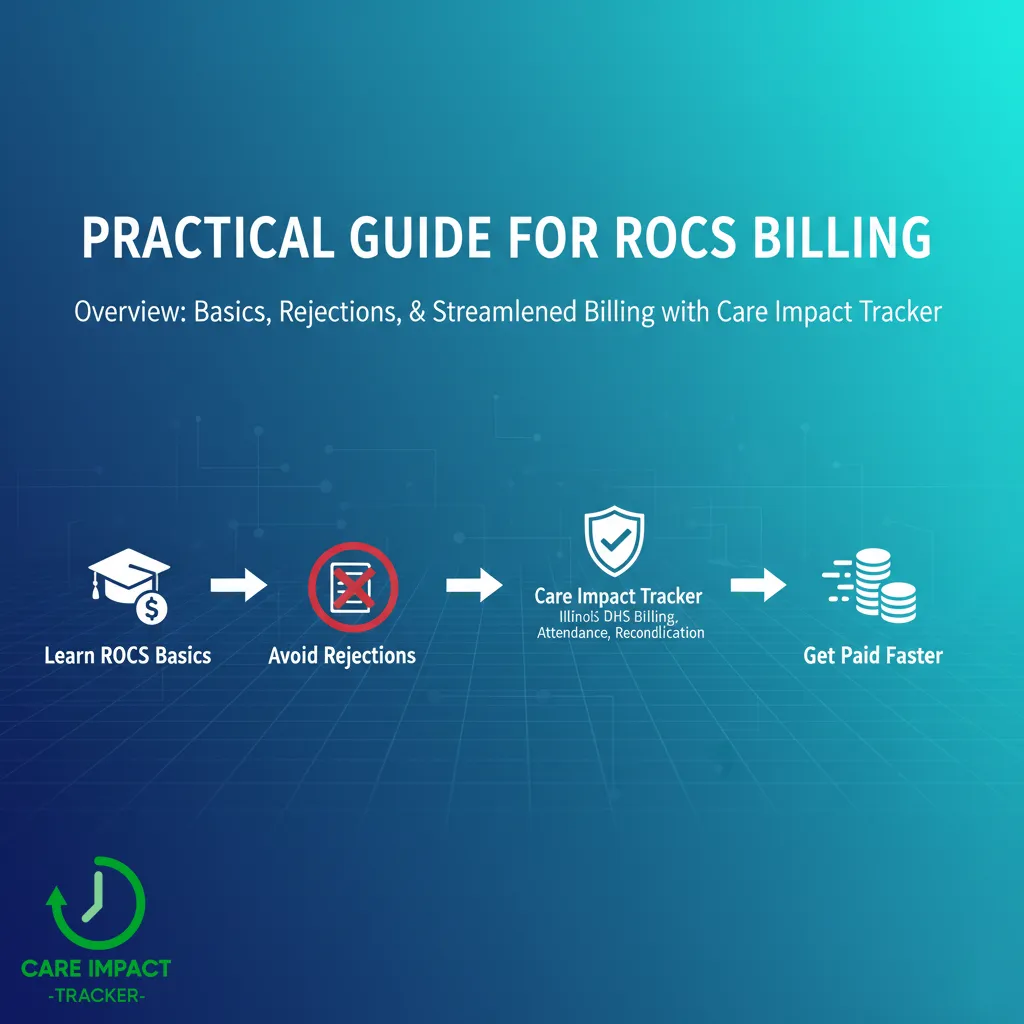
Promise: This guide explains how Illinois DHS ROCS works, where most rejections come from, and a step-by-step monthly checklist you can copy. We’ll also show how Care Impact Tracker (CIT) streamlines attendance, file generation, and reconciliation—so you submit clean claims and get paid faster.
Preview: You’ll learn (1) ROCS basics and 60D in plain English, (2) a “clean-exports” checklist, (3) reports that prevent end-of-year surprises, (4) realistic pricing and fit, and (5) alternatives to compare.
What “ROCS” Means in Practice (and Why It’s Hard)
ROCS is the Illinois DHS Community Reporting System—a PC-based application providers use to assemble client data and submit service/billing files to DHS. In practice, you maintain provider and client records, build service/billing records (e.g., FFS), transmit files for processing, then retrieve result files that include warnings/rejections. It’s powerful—but highly procedural and easy to break if data is incomplete or out of sync. dhs.state.il.us+1
Quick context on 60D and CILA
60D is the program code for CILA (Individual Rate Model) per-diem billing—bill daily for each date the individual receives residential services (up to 365 days in a fiscal year). This nuance often affects your lapse period planning and unit math. dhs.state.il.us
Pro tip: The Division of Developmental Disabilities periodically updates guidance affecting billing cut-offs and exceptions (e.g., notes about 60D vs. other bill codes). Keep an eye on DDD communications to avoid last-minute scrambles. dhs.state.il.us
The “Clean Exports” Monthly Checklist (Copy This)
If your team follows a tight checklist, you catch issues before result files do.
Verify agency/provider records. Confirm provider records and geo codes are up to date. If provider data is stale, downstream files fail. dhs.state.il.us
Validate client case data. Confirm demographics, DD segments, guardianship, and income info. Small mismatches here commonly trigger rejections. dhs.state.il.us
Reconcile attendance/service logs. Ensure daily check-in/out completeness for CILA/day programs; confirm indirect hours (therapy/counseling) and monthly attendance entries as needed. Gaps or overlaps surface later as unit or date errors.
Create the right records. Build Fee-for-Service (FFS) or service reporting records per program; confirm bill codes and units align with DHS guidance. Wrong code/unit logic is a top rejection driver. dhs.state.il.us
Transmit files to ROCS and capture the processing time. Document who submitted which batch and when. dhs.state.il.us
Import and review result files. Investigate warnings/rejections, correct the source (client/provider/attendance), then regenerate only what’s needed. Reconcile payments as they arrive to close the loop. dhs.state.il.us

How Care Impact Tracker (CIT) Helps (Education-first, product-second)
CIT centralizes attendance, prevents unit/date mistakes with real-time validation, and automates the ROCS file workflow—so your team spends less time hunting problems and more time closing them.
• One dashboard for action: See open check-ins, missing attendance, pending financial reviews, and unbilled services. Click straight to the item; fix it before cut-off.
• Attendance that mirrors real life: Daily check-in/out, monthly attendance, and indirect hours—filtered by program, residence, and provider across CILA, day, and vocational sites. Built-in validation flags gaps and overlaps where they start.
• ROCS file generation and reconciliation: Generate export-ready files (e.g., client, provider, FFS/service reporting categories), submit, then auto-import result files to show what was paid, rejected, and why—no manual FTP gymnastics.[Placeholder GIF: “Export → Submit → Auto-reconcile” flow]
Real-world impact: “We had our 60D billing done on the first business day of the month… Previously, it took almost two weeks just to enter data, transmit it, and record revenue.”— Ken Gaul, CFO, Helping Hand
Reports That Prevent Surprises (and Make Audits Boring)
When reports align with DHS rules and your attendance reality, audits become proof—not panic.
• Billing Audit Report → compare attendance hours to billed units to catch over/under runs before you submit.
• Remaining Hours (year-to-date) → see DHS-covered time left in the fiscal year by client/program; no more end-of-year “oops.”
• Payment Summary & Year-over-Year → track cash timing, rejection patterns, and program performance—so finance can forecast with confidence.
DHS vs. HFS: Where 837/835 Fits (Roadmap Awareness)
DHS ROCS is its own ecosystem for DD service reporting and FFS billing. HFS (Illinois Medicaid) uses HIPAA EDI standards like 837 (claims) and 835 (remittance); many mixed-funding agencies need both worlds. If you serve DHS and insurance-funded programs, plan for 837/835 alongside ROCS. HFS+1
Heads-up on change: There’s an Illinois bill (HB2491) proposing a plan to replace/upgrade ROCS by January 1, 2026. Even if timelines shift, building clean data and repeatable processes now will pay off during any transition. trackbill.com+1
Security & Scale (Short and Plain)
CIT is multi-tenant (data isolated per agency) and hosted on Microsoft Azure, with role-based permissions and audit trails. If you require formal attestations (e.g., SOC), ask during scoping so we match your compliance posture. Security claims should be specific; bring your checklist to the demo.
Frequently Asked Questions
• What exactly is ROCS again? The DHS Reporting of Community Services (ROCS) system is the official platform for providers to submit required DD service/billing data to the state. dhs.state.il.us
• What’s special about 60D? It’s the CILA per-diem program code; bill daily for present days (up to 365 per fiscal year). dhs.state.il.us
• Do I still need 837/835? If you also bill HFS/Medicaid, yes—837 for claims, 835 for remittance.